Judith Huemer 
Judith Huemer
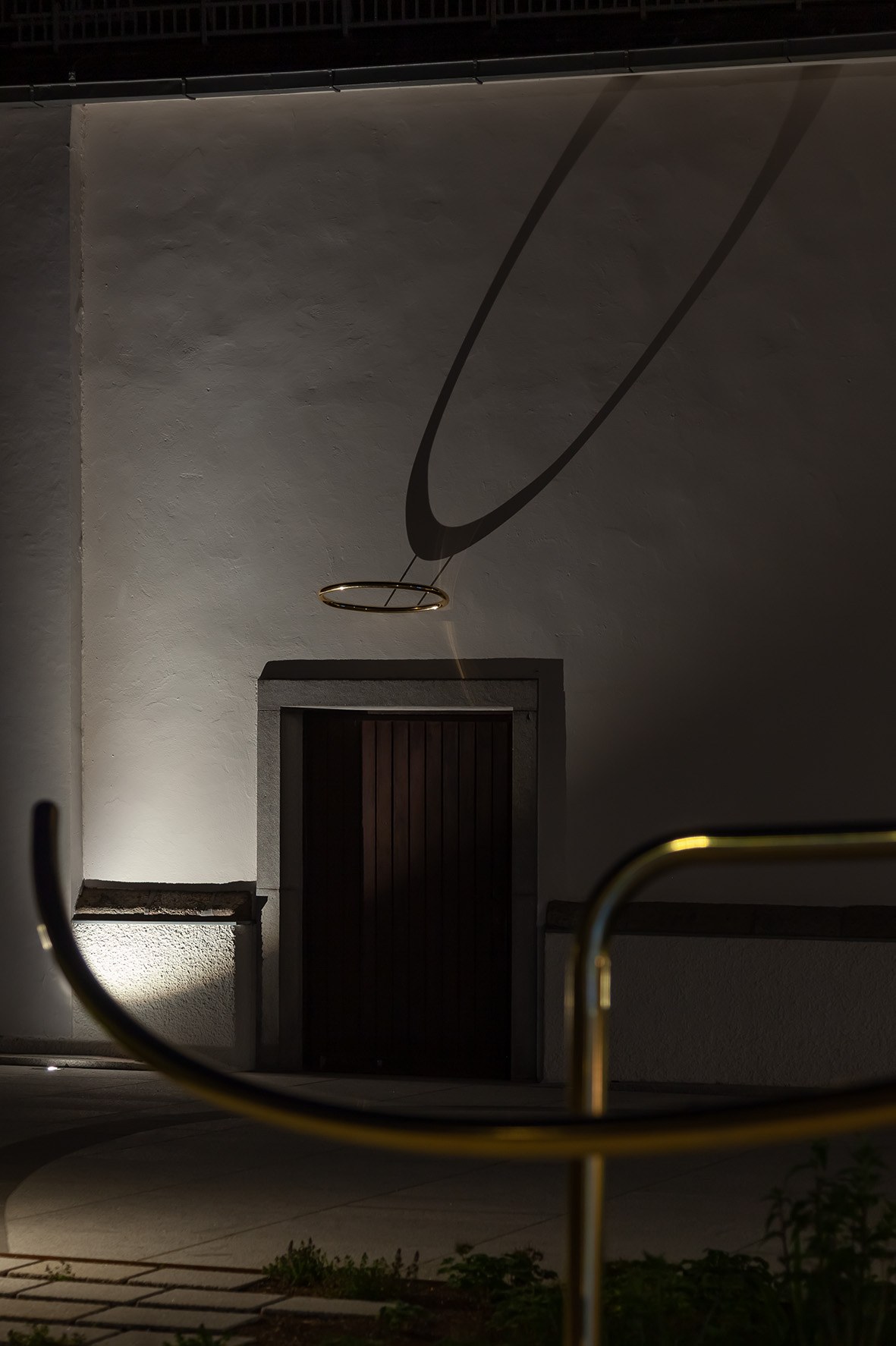
Site-specific sculptural installation, 2025/26
Invited artistic competition — Jakobskirche, Schönau im Mühlkreis, Austria
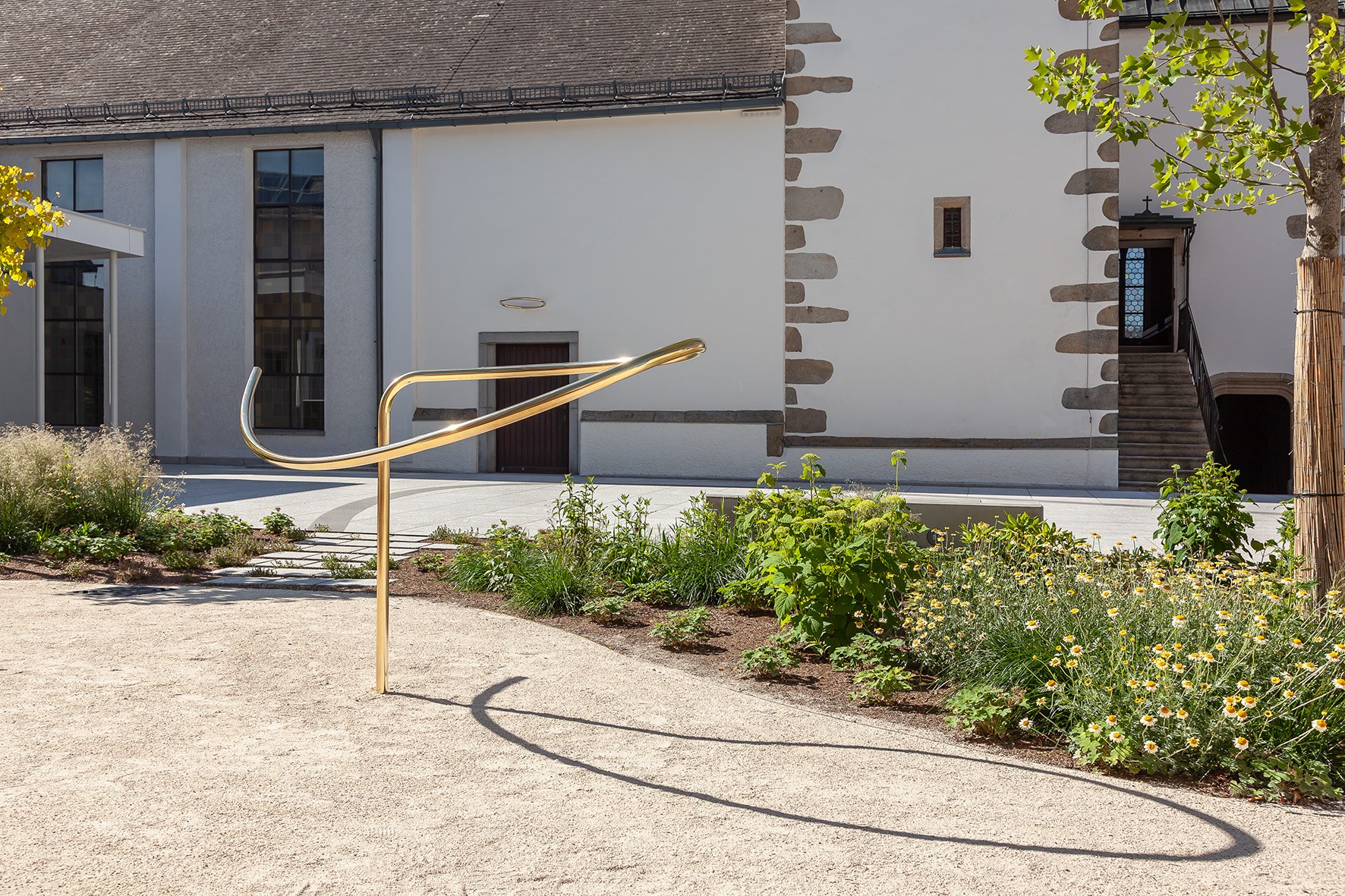
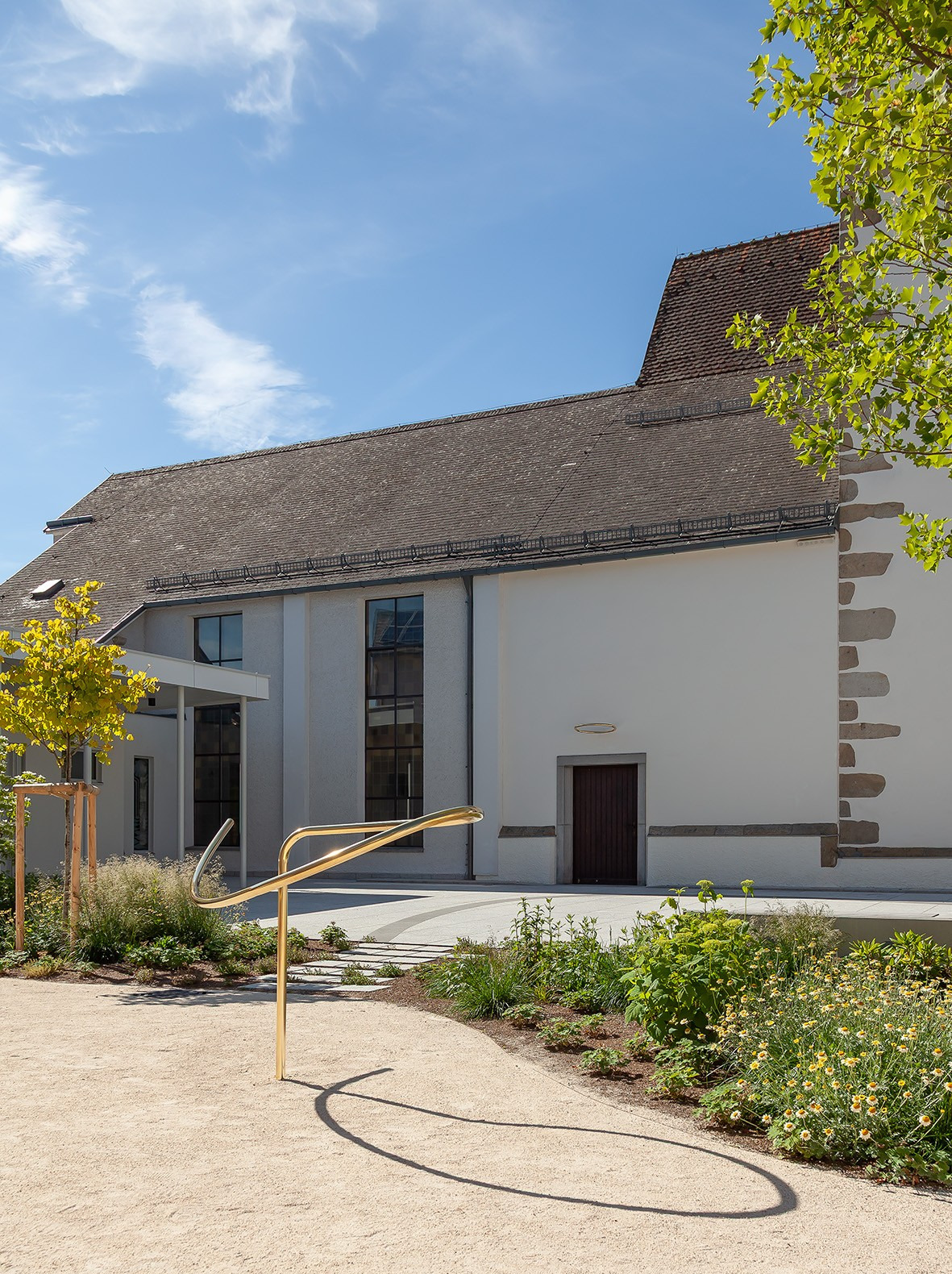
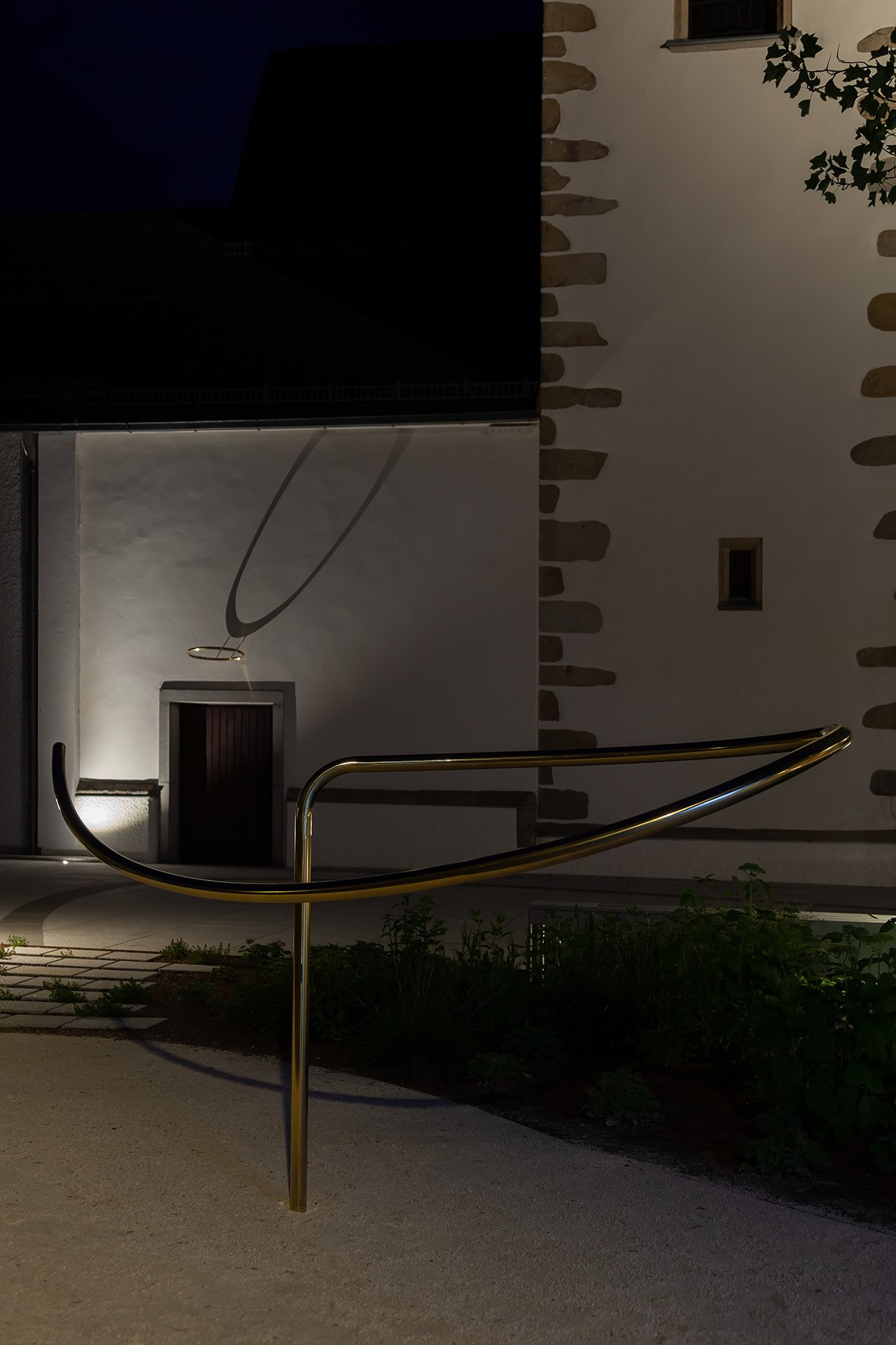
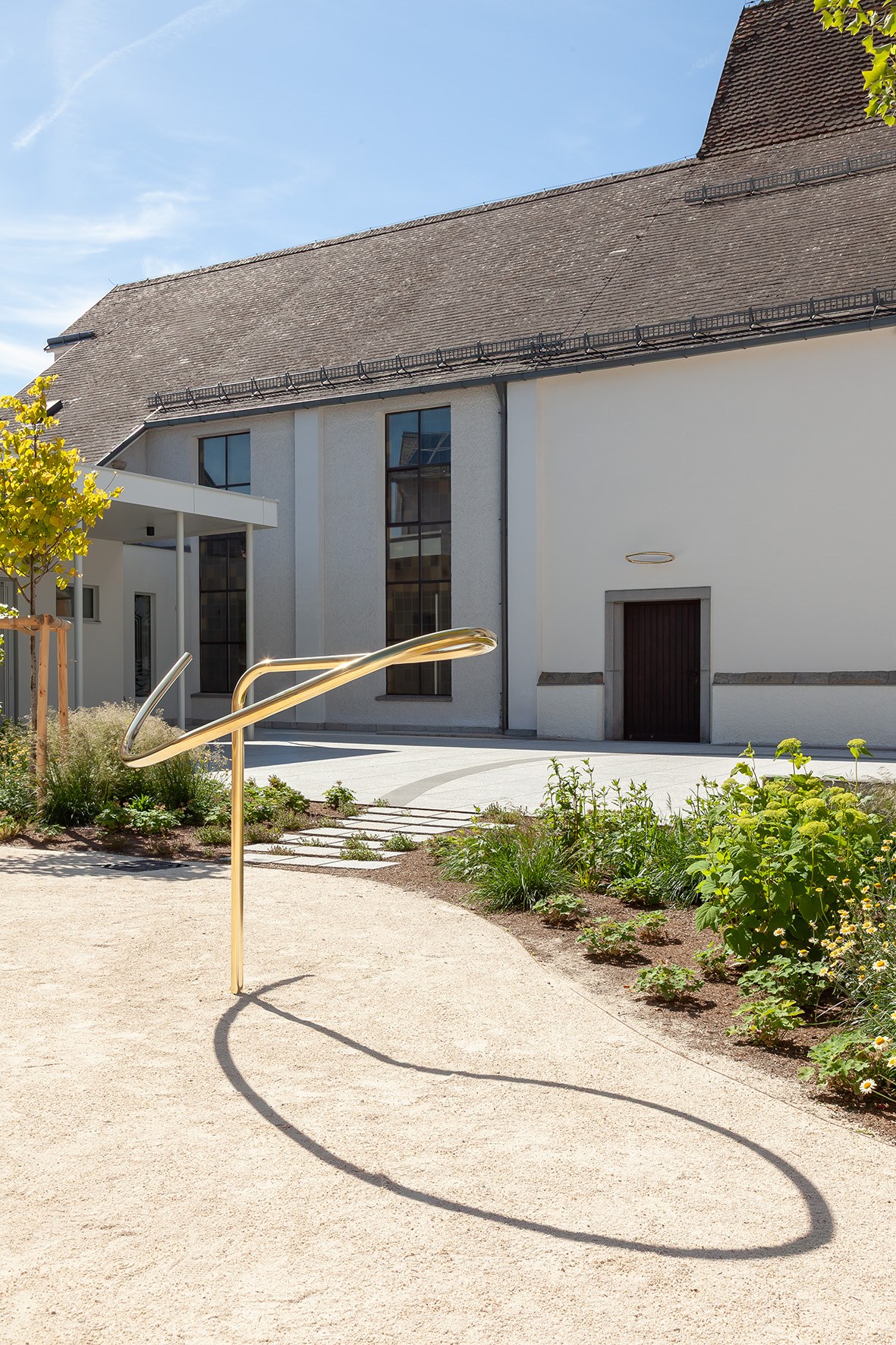
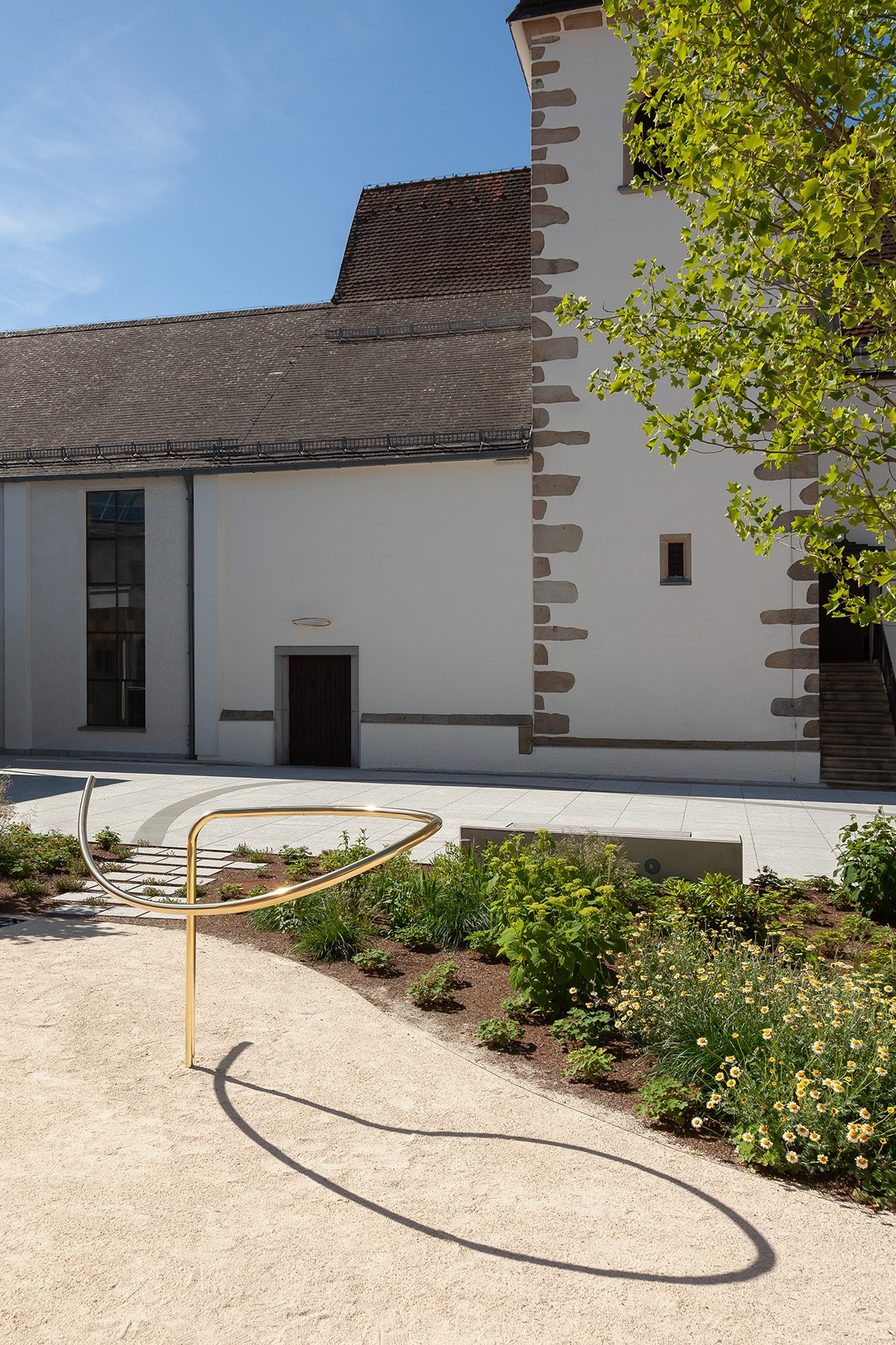
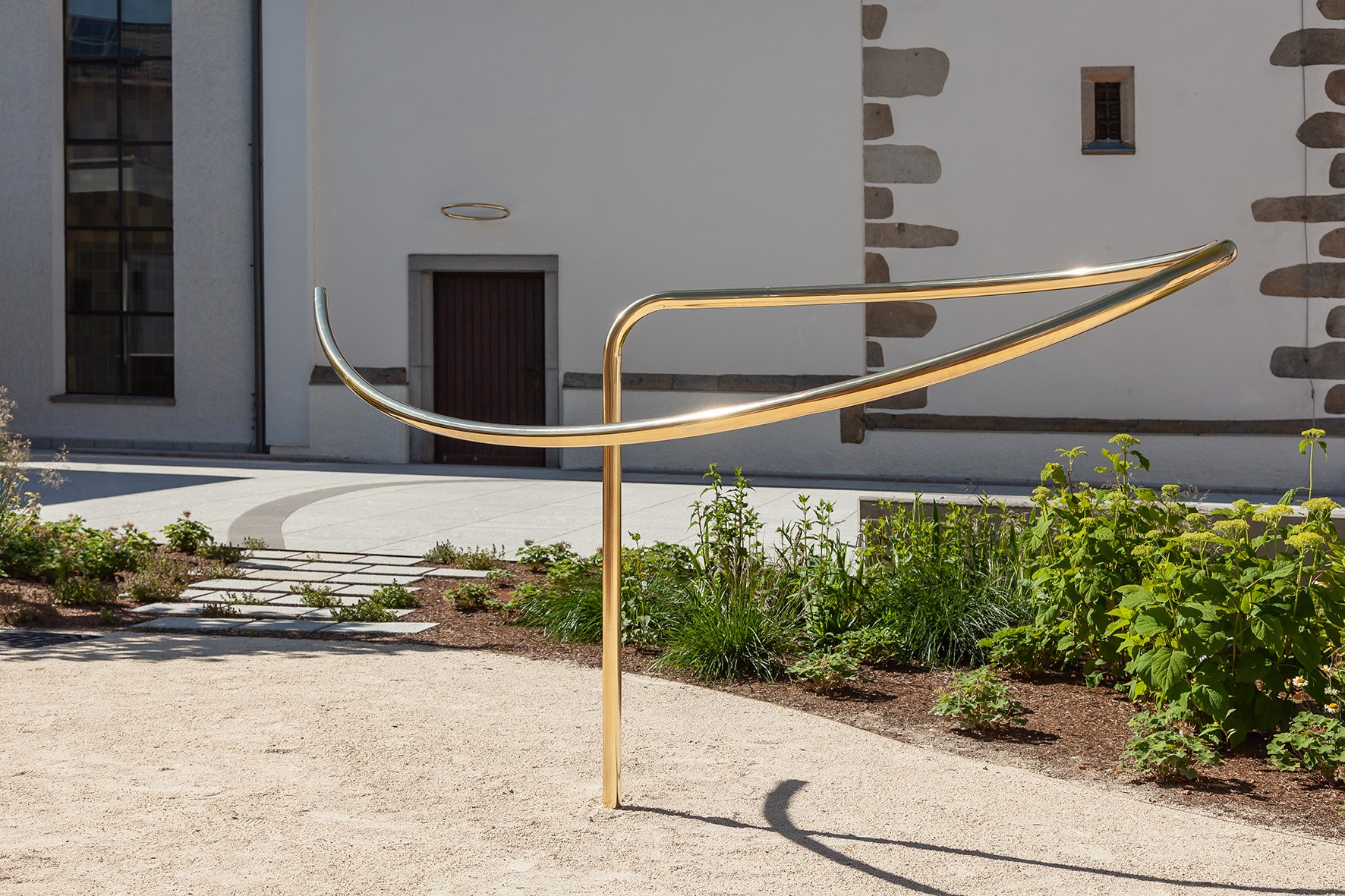
Created for the forecourt and portal of the Jakobskirche in Schönau im Mühlkreis – a historic site on the pilgrimage route to Santiago de Compostela – this permanent, site-specific work takes up the tradition of pilgrimage as its artistic and spiritual guiding idea. Its three elements – Pilgrim's Staff, Ground Line and Ellipse – make the stages of life's journey tangible: setting out, searching, arriving. The trilogy unites opposites – grounding and upward movement, stability and dynamism – reduced, inviting and contemplative.
Pilgrim's Staff: the sculpture stands without a pedestal, directly connected to the ground – like a walking stick that offers support without weighing one down. The vertical line stands for grounding and stability; the gentle curve into the horizontal reads like a handrail – a sweeping arc, balance, upward movement. Its brass-gold surface responds to the sacred surroundings.
Ground Line: a curved path across the forecourt, powerful in gesture and calm in effect. It follows the motif of being on a journey and intuitively leads towards the main portal, creating a generous, open and contemplative space.
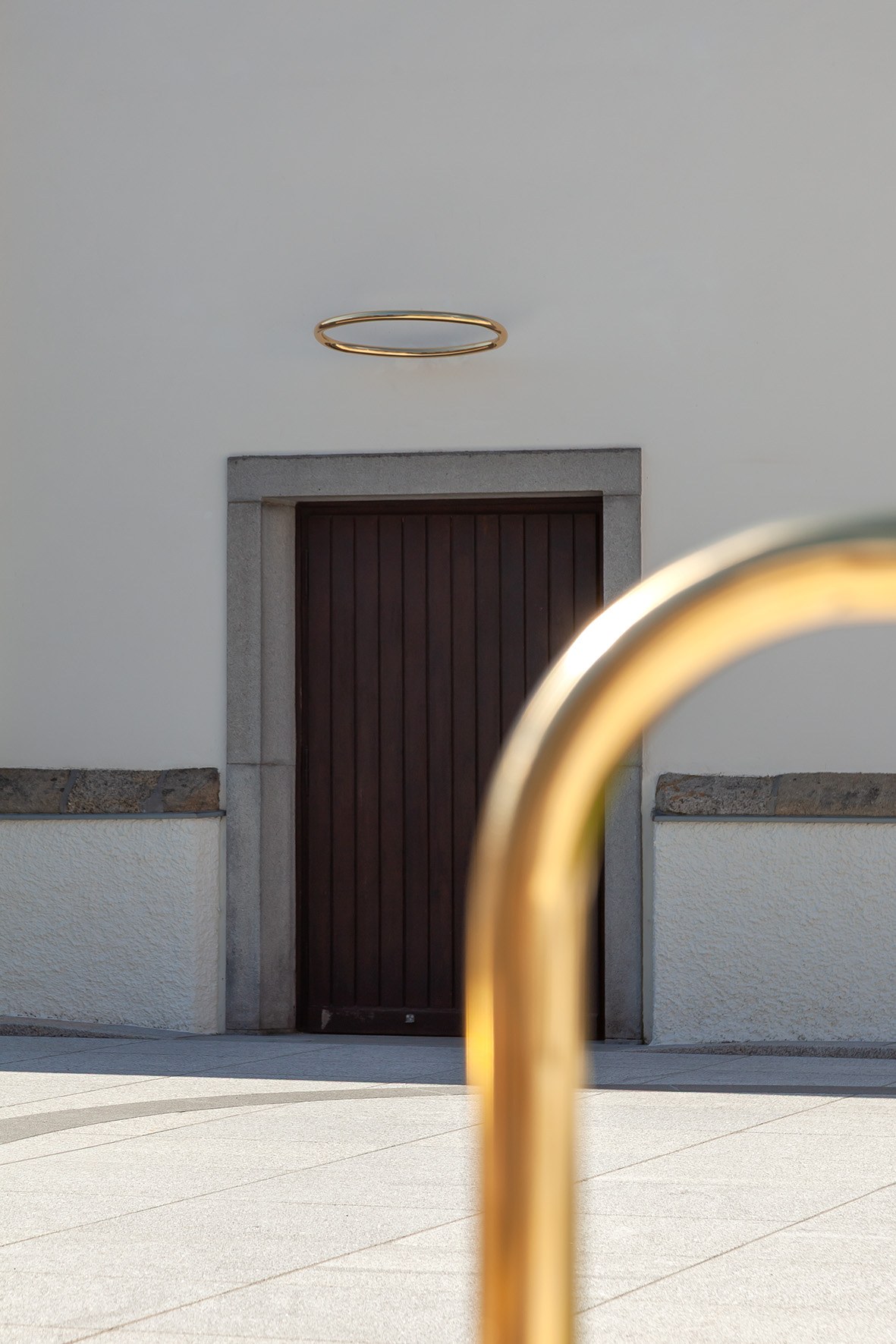
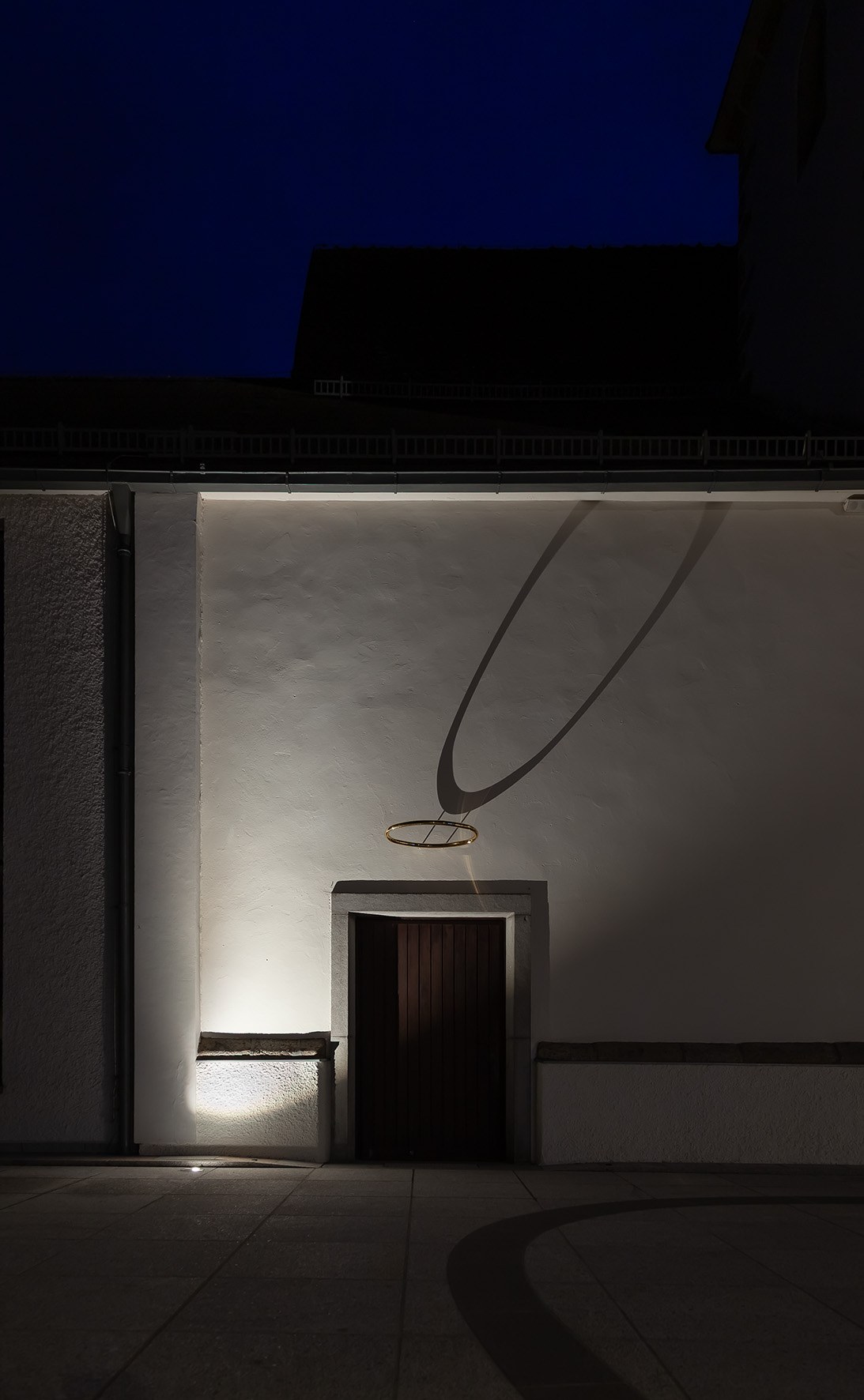
Ellipse: the object above the main portal completes the trilogy as a symbol of wholeness, unity and eternity. Lit from below, it glows as a halo of light visible from afar, drawing the eye to the entrance and inviting reflection and contemplation.
“The starting point was the ritual of pilgrimage: the question of meaning, of inner and outer support, of what sustains us. The shimmering golden surface connects the uniqueness of life with the sacred space of the Jakobskirche. The work invites us to pause — and yet it is in motion: it changes with the light, with the time of day, with the people who touch it and pass through it.” — Judith Huemer
“An impressive interplay of spirituality and art”
At first glance, the interventions appear minimalist and restrained, yet they are compelling precisely because they directly incorporate the site's existing conditions. With the organic form of the arc and the rounded elements, they provide a counterpoint to the building's simplicity – while at the same time echoing it.
— Martina Gelsinger, art historian and curator, Department of Art, Diocese of Linz
“A wealth of interpretations”
Form, surface, and the interplay of shadows – both in sunlight and in darkness – leave room for a wealth of interpretations: a quiet and, precisely because of that, powerful answer to the question of site-specific artistic design.
— Peter Schneider, architect, Schneider Lengauer Pühringer Architekten ZT GmbH, responsible for the redesign of the church square
“Lightness and movement”
The organic quality of the three elements does the place good. I keep observing it anew, and when I touch the staff, I feel its vibration, its momentum, its vitality – and take that with me.
— Barbara Brandstätter, landscape architect, responsible for the design of the pilgrim garden
The work is freely accessible at the forecourt and portal of the church.
Realized 2025/26 on behalf of the Verschönerungsverein and Tourismusforum Schönau, in collaboration with the parish of Schönau im Mühlkreis and the Department of Art of the Diocese of Linz. Dedicated on 26 April 2026.
Technical assistance: T. Sandri · Production: W. Prohaska – Kunsthandwerk · Photos: Ulrich Kehrer
Das permanente, ortsspezifische Gesamtkunstwerk für Vorplatz und Portal der Jakobskirche in Schönau im Mühlkreis – einem historischen Ort am Pilgerweg nach Santiago de Compostela – greift die Tradition des Pilgerns als künstlerische und spirituelle Leitidee auf. Seine drei Elemente – Pilgerstab, Bodenlinie und Ellipse – machen die Etappen eines Lebensweges erfahrbar: Aufbruch, Suche, Ankommen. Die Trilogie vereint Gegensätze – Erdung und Aufwärtsbewegung, Stabilität und Dynamik – reduziert, einladend und kontemplativ.
Pilgerstab: Die Skulptur steht ohne Sockel, direkt mit dem Boden verbunden – wie ein Wanderstab, der Halt gibt, ohne zu beschweren. Die Vertikale steht für Erdung und Stabilität, der sanfte Schwung in die Horizontale liest sich wie ein Handlauf – ein weiter Bogen, Balance, Aufwärtsbewegung. Die messinggoldene Oberfläche antwortet auf das sakrale Umfeld.
Bodenlinie: Eine geschwungene Spur über den Vorplatz, kraftvoll in der Geste und ruhig in der Wirkung. Sie folgt dem Leitmotiv des Unterwegsseins und führt intuitiv zum Hauptportal – es entsteht ein großzügiger, offener und kontemplativer Raum.
Ellipse: Das Objekt über dem Hauptportal vollendet die Trilogie als Symbol für Ganzheit, Einheit und Ewigkeit. Von unten beleuchtet, erstrahlt sie als weithin sichtbarer Lichtschein, der zu Einkehr und Andacht einlädt.
„Ausgangspunkt war das Ritual des Pilgerns: die Frage nach Sinn, nach innerem und äußerem Halt, nach dem, was trägt. Die goldglänzende Oberfläche verbindet die Besonderheit des Lebens mit dem sakralen Raum der Jakobskirche. Das Werk lädt ein zum Innehalten — und ist doch in Bewegung: Es verändert sich mit dem Licht, mit der Tageszeit, mit den Menschen, die es berühren und durchqueren." — Judith Huemer
„Ein eindrucksvolles Zusammenspiel von Spiritualität und Kunst"
Auf den ersten Blick wirken die Interventionen minimalistisch und zurückhaltend, doch gerade weil sie die vorhandenen Gegebenheiten des Ortes direkt einbeziehen, üben sie eine besondere Faszination aus. Mit der organischen Form des Bogens und den runden Elementen bilden sie einen Kontrapunkt zur Schlichtheit des Gebäudes – und greifen diese zugleich auf.
— Martina Gelsinger, Kunsthistorikerin und Kuratorin, Fachbereich Kunst der Diözese Linz
„Vielzahl an Interpretationen"
Form, Oberfläche und Schattenspiel bei Sonne wie Dunkelheit lassen Raum für eine Vielzahl an Interpretationen – eine stille und gerade deshalb kraftvolle Antwort auf die Frage nach ortsspezifischer künstlerischer Gestaltung.
— Peter Schneider, Architekt, Schneider Lengauer Pühringer Architekten ZT GmbH, verantwortlich für die Umgestaltung des Kirchenplatzes
„Leichtigkeit und Beweglichkeit"
Das Organische der drei Elemente tut dem Ort gut. Ich beobachte es immer wieder aufs Neue, und wenn ich den Stab berühre, spüre ich sein Vibrieren, seinen Schwung, seine Lebendigkeit – und nehme das mit mir.
— Barbara Brandstätter, Landschaftsarchitektin, verantwortlich für die Gestaltung des Pilgergartens
Das Werk ist frei zugänglich, direkt bei Vorplatz und Portal der Kirche.
Realisiert 2025/26 im Auftrag des Verschönerungsvereins und Tourismusforums Schönau, in Zusammenarbeit mit der Pfarre Schönau im Mühlkreis und dem Fachbereich Kunst der Diözese Linz.
Technische Assistenz: T. Sandri · Produktion: W. Prohaska – Kunsthandwerk · Fotos: Ulrich Kehrer
© Judith Huemer